In various conferences of the United Nations on the Law of the Sea, the Philippines and other archipelago states proposed that an archipelagic state composed of groups of islands forming a state is a single unit, with the islands and the waters within the baselines as internal waters.By this concept (archipelagic doctrine), an archipelago shall be regarded as a single unit, so that the waters around, between, and connecting the islands of the archipelago, irrespective of their breadth and dimensions, form part of the internal waters of the state, subject to its exclusive sovereignty.

Despite the opposition of maritime powers, the Philippines and four other states (Indonesia, Papua New Guinea, Fiji and Bahamas) got the approval in the UN Convention on the Law of the Sea held in Jamaica last December 10, 1982. They were qualified as archipelagic states. The archipelagic doctrine is now incorporated in Chapter IV of the said convention. It legalizes the unity of land, water and people into a single entity
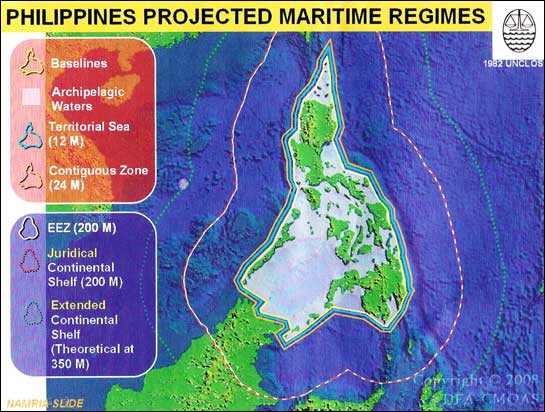
photo courtesy of gmanews.tv
The Philippines bolstered the archipelagic principle in defining its territory when it included in Article 1 of the 1987 Constitution the following:
:
"The national territory comprises the Philippine Archipelago, with all the islands and waters embraced therein xxx"; and
"The waters around, between and connecting the islands of the archipelago, regardless of their dimensions, form part of the internal waters of the Philippines."
The archipelagic principle however is subject to the following limitations:
a) respect for the right of the ship and other states to pass through the territorial as well as archipelagic waters
b) respect to right of innocent passage
c) respect for passage through archipelagic sea lanes subject to the promulgation by local authorities of pertinent rules and regulations.
