Tuesday, June 08, 2010
GOVERNMENT VS ADMINISTRATION
Government is distinct from administration. Government is the agency which formulates, expresses and realizes the will of the people. On the other hand, administration is composed of group of persons in whose hands the reins of government are for the time being. It is the administration that runs the affairs of the government for a given period of time, after which another administration may be called upon by the people to serve them. That is why we say that administration changes but the government does not.

FUNCTIONS OF GOVERNMENT
There are two functions of government: constituent and ministrant.
Constituent functions are those which constitute the very bonds of society and are compulsory in nature. Examples are keeping of order and providing for the protection of persons and property; the fixing of the legal relations between man and wife, and between parents and child; the regulation of property and the determination of contract rights; the definition and punishment of crime, the administration of justice, the determination of political duties, privileges, and relations of citizens, dealings of the state with foreign powers, the preservation of the state from external danger and the advancement of international interest.

Constituent functions are those which constitute the very bonds of society and are compulsory in nature. Examples are keeping of order and providing for the protection of persons and property; the fixing of the legal relations between man and wife, and between parents and child; the regulation of property and the determination of contract rights; the definition and punishment of crime, the administration of justice, the determination of political duties, privileges, and relations of citizens, dealings of the state with foreign powers, the preservation of the state from external danger and the advancement of international interest.

photo courtesy of http://www.mrdonn.org/
Ministrant functions are those that are undertaken only by way of advancing the general interests of society and are merely optional. Examples are public works, public education, public charity, health and safety regulations and regulations of trade and industry.
FORMS OF GOVERNMENT
The following are the forms of government:
- As to the number of persons exercising sovereign powers:
- Monarchy - the supreme authority is in the hands of a one person only; how he got into power or how long his tenure would be does not matter
- Absolute monarchy - the power of the monarch is based on divine right
- Limited monarchy - the power of the monarch is based on the constitution
- Aristocracy - the ruling power is in the hands of a few privileged class
- Democracy - the power is in the hands of the people
- Direct or pure democracy - the power is directly exercised by the people through assembly or mass meeting.
- Indirect, representative or republican - the power is exercised by a group of persons chosen by the people to act as their representatives
- As to extent of powers exercised by the central or national government:
- Unitary government - the control of national and local affairs is under the central or national government
- Federal government - the powers of the government are divided between two sets of organs, one for national and the other for local affairs, each organ being supreme within its own sphere
- As to relationship between the executive and the legislative branches of the government:
- Parliamentary government - the executive is dependent on the legislative
- Presidential government - the executive is constitutionally vested with powers making it independent from legislative department
- Other forms:
- Civil government - the affairs of the state are administered and directed by the citizens or their representatives
- Military government - established and administered by a belligerent in the territory of an enemy occupied by him
- Constitutional government - the powers of those who rule are defined and limited by the constitution
- Despotic government - the powers of those who rule are vague and may seem limitless because it is not defined nor limited by the constitution
- Elective government - the state confers powers upon a person or organization chosen by qualified voters and the holding of powers is for a limited term and under certain conditions
- Hereditary government - the state confers the powers of government upon a person or organization standing in a certain family relations to his or their immediate predecessors
- Coordinate government - the powers of the government is distributed among separate departments equally independent of but coordinate with each other
- Consolidated government - the state confides all governmental powers to a single body
- De jure government - established according to the constitution of the state and has the general support of the people
- De facto government - established against existing constitution of the state and is maintained against the rightful and lawful government
- Revolutionary government - installed, whether by force or otherwise, not in accordance with the procedure prescribed in an existing constitution
GOVERNMENT

Purpose and necessity
Government is created for the benefit of the people governed. It performs services or functions that are beyond the capabilities of any individual or enterprise. The chief purposes of government are: the maintenance of peace and order, the protection of persons and property, the administration of justice, the promotion of education, the preservation of the state from external danger, and the advancement of the physical, economic and social and cultural well-being of the people. (De Leon, 1991)
The organized structure of the government enables the state to smoothly administer its affairs. Without government, chaos and disorder will prevail.
Monday, June 07, 2010
OUTER SPACE THEORY

The Outer Space Theory is an international multilateral agreement that sets forth the fundamental principles governing the international law of outer space. Over eighty (80) states are parties to the Outer Space Treaty.
The Outer Space Theory provides that outer space, including the moon and other celestial bodies, is free for exploration and use by all states and cannot be claimed by any state. Any exploration and use must be for the benefit of all states on a basis of equality and in accordance with international law and due regard to interests of other states. The explorations and use must not result to any harmful contamination of the outer space and the earth as well.
The state conducting space activities must as far as practicable disclose information about such activities. Stations and equipment should be open in case other states demand for inspection. For activities that are sponsored by non-government organizations, authorization and supervision of the government bearing international responsibility of such activities are required. On the other hand, responsibility is on the organization and its members if the activities are under intergovernmental organizations. Further, the state that launched or authorized the launching of an object into the outer space is liable for any damage it may cause.
The austronauts are regarded as envoys of mankind in outer space. In case of distress or emergency landing in another state, they must be promptly returned to the state of the space vehicle's registry.
Finally, the treaty also demilitarizes the moon and other celestial bodies.
MOON TREATY

All activities on the moon are to be carried out in the interest of peace with due regard to the interest of all the parties and other states. The moon is demilitarized and nuclear weapons or other weapons of mass destruction should not be deposited in it. (Coquia and Santiago, 2005).

photos courtesy of http://www.googlelunarxprize.org/ and
THE PHILIPPINES AND THE ARCHIPELAGIC DOCTRINE
In various conferences of the United Nations on the Law of the Sea, the Philippines and other archipelago states proposed that an archipelagic state composed of groups of islands forming a state is a single unit, with the islands and the waters within the baselines as internal waters.By this concept (archipelagic doctrine), an archipelago shall be regarded as a single unit, so that the waters around, between, and connecting the islands of the archipelago, irrespective of their breadth and dimensions, form part of the internal waters of the state, subject to its exclusive sovereignty.

Despite the opposition of maritime powers, the Philippines and four other states (Indonesia, Papua New Guinea, Fiji and Bahamas) got the approval in the UN Convention on the Law of the Sea held in Jamaica last December 10, 1982. They were qualified as archipelagic states. The archipelagic doctrine is now incorporated in Chapter IV of the said convention. It legalizes the unity of land, water and people into a single entity
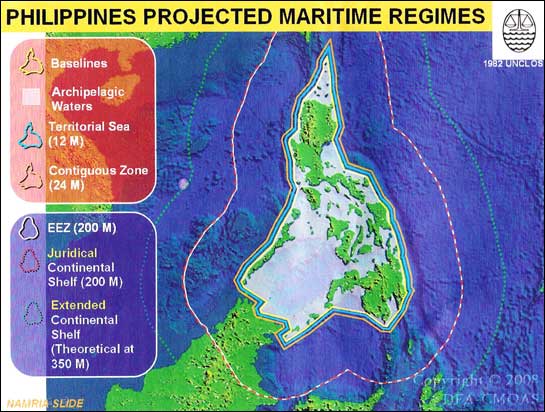
photo courtesy of gmanews.tv
The Philippines bolstered the archipelagic principle in defining its territory when it included in Article 1 of the 1987 Constitution the following:
:
"The national territory comprises the Philippine Archipelago, with all the islands and waters embraced therein xxx"; and
"The waters around, between and connecting the islands of the archipelago, regardless of their dimensions, form part of the internal waters of the Philippines."
The archipelagic principle however is subject to the following limitations:
a) respect for the right of the ship and other states to pass through the territorial as well as archipelagic waters
b) respect to right of innocent passage
c) respect for passage through archipelagic sea lanes subject to the promulgation by local authorities of pertinent rules and regulations.
THE PHILIPPINE TERRITORY

photo courtesy of jibrael_2007
The scope of the Philippine territory is found in Article I of the 1987 Philippine Constitution. It provides:
"The national territory comprises the Philippine archipelago, with all the islands and waters embraced therein, and all other territories over which the Philippines has sovereignty or jurisdiction, consisting of its terrestrial, fluvial, and aerial domains, including its territorial sea, the seabed, the subsoil, the insular shelves, and other submarine areas. The waters around, between, and connecting the islands of the archipelago, regardless of their breadth and dimensions, form part of the internal waters of the Philippines."
For purposes of analysis, Philippine national territory includes the following:
(a) the Philippine archipelago, with all the islands and waters embraced therein;
(b) all other territories over which the Philippines has sovereignty or jurisdiction consisting of territorial, fluvial and aerial domains;
(c) the territorial sea, the seabed, the subsoil, and insular shelves and other submarine areas; and
(d) the waters around, between, and connecting the islands of the archipelago, regardless of their breadth and dimensions.
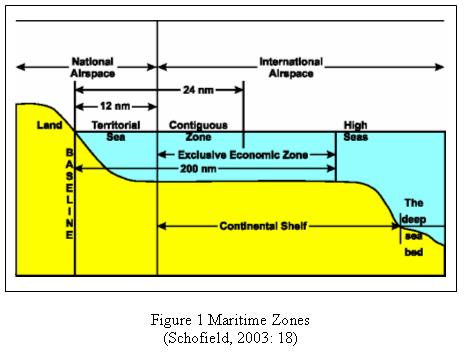
photo courtesy of http://madeandi.staff.ugm.ac.id/images/mz.JPG
Seabed is the land that holds the sea, lying beyond the seashore, including mineral and natural resources. It is at the top portion of the submarine area.
The subsoil is everything beneath the surface soil and the seabed including mineral and natural resources.
Insural shelves are the submerged portions of a continent or offshore island, which slope gently seaward from the low waterline to a point where a substantial break in grade occurs, at which point the bottom slopes seaward at a considerable increase in slope until the great ocean depths are reached; and
Other submarine areas refers to those which are under the territorial sea. They are ottherwise referred to as seamount, trough, trench, deep, bank, shoal, and reef.
Useful links:
http://www.ellentordesillas.com/?p=2346
http://verafiles.org/docs/pd1596.pdf
http://www.newsflash.org/2004/02/pe/pe004395.htm
http://www.positivenewsmedia.net/am2/publish/Main_News_1/PGMA_signs_RP_Archipelagic_Baseline_Law.shtml
http://www1.american.edu/TED/spratly.htm
http://www.pinoypress.net/2009/02/22/arroyos-new-baseline-is-a-sellout-to-china-cpp/
Friday, June 04, 2010
TERRITORY
Territory is the fixed portion of the surface of the earth inhabited by the people of the State. It is fixed because there are groups that may seem to appear to have all the elements of the state but actually they are not. Examples of these are freebooters sailing the seas, nomadic tribes or even patriotic revolutionaries. They exist independent of external control, have governments of their own. One thing though, their territories are not definite. They have ephemeral existence, thus, they cannot be considered as states.
Territory is one of the fundamental attributes of a state because the exercise of sovereignty is established upon it. Where can the state exercise its authority or demand duties if it lacked territory?
Territory has three components. They are the land mass otherwise known as terrestrial domain, the inland and external waters, which make up the maritime and fluvial domain, and the air space above the land and waters, which is called the aerial domain.
There is also no requirement as to the size of the territory although it must be neither too big as to be difficult to administer and defend nor too small as to be unable to provide for the needs of the population. Thus a state may cover a vast expanse of continent like of Russia and China or it may only occupy only a few square miles like the Vatican City.
Size is of no legal significance but when it comes to practical politics and international relations, it is obviously material. An independent community occupying only a few square miles of territory is of very little importance in the game of world politics. (Sinco, 1962)
Territory is one of the fundamental attributes of a state because the exercise of sovereignty is established upon it. Where can the state exercise its authority or demand duties if it lacked territory?
Territory has three components. They are the land mass otherwise known as terrestrial domain, the inland and external waters, which make up the maritime and fluvial domain, and the air space above the land and waters, which is called the aerial domain.
There is also no requirement as to the size of the territory although it must be neither too big as to be difficult to administer and defend nor too small as to be unable to provide for the needs of the population. Thus a state may cover a vast expanse of continent like of Russia and China or it may only occupy only a few square miles like the Vatican City.
Size is of no legal significance but when it comes to practical politics and international relations, it is obviously material. An independent community occupying only a few square miles of territory is of very little importance in the game of world politics. (Sinco, 1962)
Tuesday, June 01, 2010
PEOPLE

People are the basic component of a state. Without people, there can be no functionaries to govern and no subjects to be governed. The people forming the state need not share common racial, culture, ideological or commercial interests. What is important is they have common political ends.
There are two interpretations on the term people. Some refers the term people to the voters only because it is only through voting that the consent of the people is obtained. On the other hand, some considers people as a collective unit because they believe that as an aggregate or mass of individuals who constitute the state, in them lodged the political power, and this power is considered to be inherent. It is but another way of stating the fundamental truth on which free institutions are based, the right of the majority to rule. It is in this context that the term people is used in Section 1, Article II of the 1987 Philippine Constitution. It says: "The Philippines is a democratic and republican State. Sovereignty resides in the people and all government authority emanates from them." In a representative government all powers of government belong ultimately to the people in their sovereign corporate capacity.
There is no requirement as to the number of people that should compose a state. But it is important that they be numerous enough to be self-sufficing and to defend themselves and small enought to be easily administered and sustained. As to date, China has the biggest population with 1.3 billion. Vatican City has the smallest with only 836 citizens who are mostly clerics and Swiss guards. Currently, the Philippines has 97,976,603 population. http://www.infoplease.com/ipa/A0004379.html
(photo above courtesy of http://www.liverpool.nsw.gov.au/LCC/INTERNET/RESOURCES/IMAGES/CommunityConsultation.jpg)
Subscribe to:
Posts (Atom)